Finding Your Aerobic Heart Rate Zone:
How Aqua Aerobics Can Improve Your Heart Health Understanding your heart rate during exercise can help you get more out of your workouts. Whether you’re walking, cycling, attending a group fitness class or enjoying aqua aerobics, knowing how hard your heart is working can help you exercise at an intensity that suits your fitness level.
At Move N Motion, we believe exercise should be enjoyable, achievable and suitable for everyone. One of the best ways to improve your cardiovascular fitness is to understand your aerobic heart rate zone and find activities that help you work towards it.
Let’s look at how to calculate your target heart rate, what the different percentages mean and why aqua aerobics is such a great option for supporting heart health.
❤️ What is your aerobic heart rate zone?
Your aerobic heart rate zone is an exercise intensity where your heart and lungs are working harder to deliver oxygen to your muscles. During aerobic exercise, your body uses oxygen to help produce energy. Activities such as brisk walking, swimming, cycling, dancing and aqua aerobics can all help improve cardiovascular fitness. A commonly used training guide is to work at approximately 60–80% of your estimated maximum heart rate. This range covers a variety of aerobic training intensities.
The lower part is generally moderate intensity, while the upper part can become vigorous depending on your individual fitness.
Working at an appropriate aerobic intensity can help improve:-
Cardiovascular endurance.-
Heart and lung fitness.-
Exercise stamina.-
The body’s ability to use oxygen.-
Overall physical fitness.
Your ideal exercise intensity depends on your age, fitness level, health and individual circumstances. You don’t need to reach a particular heart rate for exercise to be beneficial.
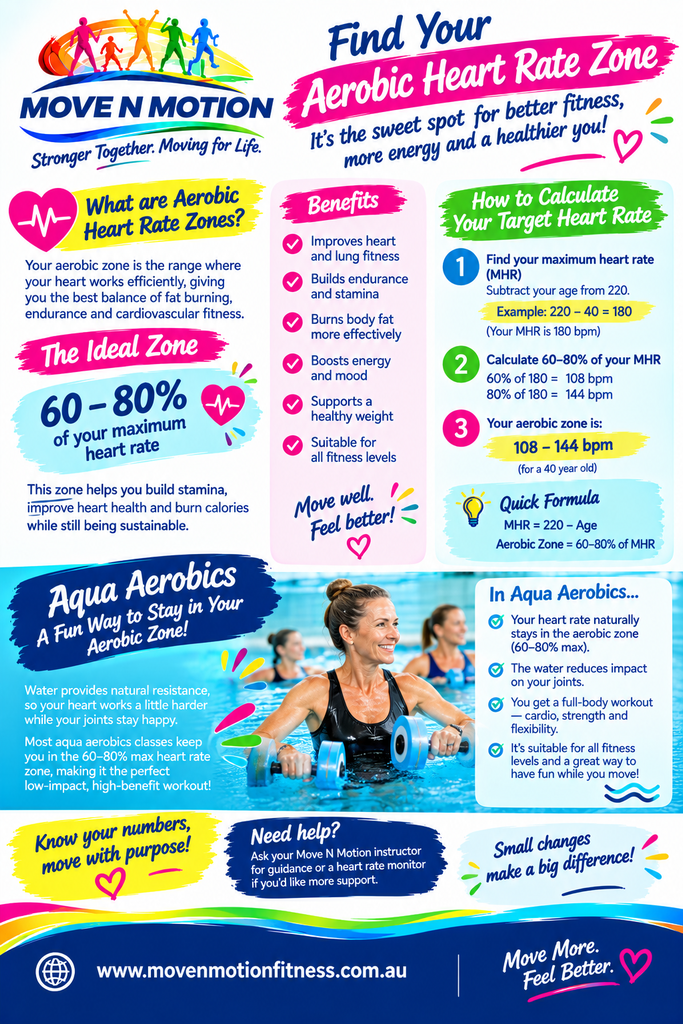
🧮 How to calculate your maximum heart rate. There is a simple formula you can use to estimate your maximum heart rate.220 minus your age = estimated maximum heart rate (MHR). For example, if you are 40 years old:220 − 40 = 180 beats per minute (bpm). This means your estimated maximum heart rate is 180 bpm. Once you have this number, you can calculate 60–80% to find your approximate aerobic training range.
Let’s work through an example for someone aged 40:
Calculation| Target heart rate Estimated maximum heart rate| 180 bpm60% of maximum| 108 bpm70% of maximum| 126 bpm80% of maximum| 144 bpmEstimated 60–80% training range: 108–144 bpm. This gives you a general guide to how hard your heart may be working during aerobic exercise.
Remember, the 220-minus-age formula is only an estimate. It does not measure your actual maximum heart rate, and individual results can vary.💓
Understanding the different heart rate zones Heart rate zones are often divided into percentages of your estimated maximum heart rate.Here is a general guide:
Zone 1 – Light activity (below approximately 50–60%) This is a comfortable intensity where you can easily talk and breathe without much effort.Examples include:- Gentle walking.- Light movement.- Warm-up and cool-down exercises.
Zone 2 – Moderate aerobic activity (approximately 50–70%) This is a useful intensity for developing cardiovascular fitness and building exercise endurance. You should notice your breathing becoming faster, but you should still be able to hold a conversation.Examples include:- Brisk walking.- Comfortable cycling.- Moderate aqua aerobics.
Zone 3 – Higher aerobic intensity (approximately 70–80%) At this intensity, your heart and lungs are working harder. You may notice:- Faster breathing.- Increased sweating.- A higher level of exertion.- More difficulty maintaining a conversation. This can help develop cardiovascular endurance as your fitness improves.
Zone 4 and above – High intensity. These higher intensities involve considerably more effort and are generally used for shorter periods of challenging exercise.They aren’t necessary for everyone, particularly if you’re new to exercise or returning after a break. The important thing is to find an intensity that challenges you without pushing beyond what is appropriate for your body.
🌊 Aqua aerobics: A great way to support heart health. Did you know aqua aerobics is an excellent form of cardiovascular exercise? Exercising in water provides a unique environment where you can combine aerobic movement, muscular strength and flexibility.
The natural resistance of water makes your muscles work against the water as you move, helping you develop strength and endurance. At the same time, the buoyancy of water supports your body and reduces the impact on your joints compared with many land-based activities.
❤️ How does aqua aerobics benefit your heart? Regular aerobic exercise encourages your heart and lungs to become more efficient at supplying oxygen to your working muscles.
Over time, consistent cardiovascular exercise can help:- Improve cardiovascular endurance.-
Support healthy blood pressure.-
Improve circulation.-
Increase exercise stamina.-
Support healthy weight management.-
Improve general health and wellbeing.
Aqua aerobics is also a great way to combine cardiovascular exercise with resistance-based movements.
💦 Why is exercising in water different? One important thing to understand is that your heart rate can respond differently when exercising in water. Water immersion, particularly around chest depth, changes how blood circulates around your body. The cooling effect of water can also influence your heart rate. This means your heart rate may be lower in water than it would be during a similar level of exercise on land. Don’t rely on heart rate numbers alone when exercising in the pool.Instead, use the talk test to help judge your intensity. For moderate-intensity exercise:- You should notice your breathing becoming faster.- Your heart should be working harder.- You should still be able to hold a conversation.- You should feel like you’re exercising, but not struggling. If you can sing comfortably, you may need to increase your effort slightly. If you’re struggling to speak, slow down and allow yourself to recover.
🏊♀️ What happens during a Move N Motion Aqua Aerobics class? Our aqua aerobics sessions combine a variety of movements designed to get your whole body working. Using the natural resistance of water, exercises can target different muscle groups while also increasing your heart rate.
Some examples include:- Water jogging and running movements.-
Side-to-side movements.-
Leg lifts and knee drives.-
Aqua dumbbell exercises.-
Core activation.-
Arm and shoulder strengthening.-
Balance and coordination exercises.
Exercises can be adjusted to suit different fitness levels, allowing participants to work at a pace that feels comfortable for them. You don’t need to be an experienced swimmer to enjoy water-based exercise, but you should be comfortable in the pool environment and follow the instructor’s safety guidance.
🌈 Fitness is for every age and ability. One of the best things about aqua aerobics is that you can adjust the intensity to suit your own ability. You don’t need to be young, extremely fit or experienced in exercise to start improving your cardiovascular fitness. Whether you’re getting back into exercise, looking for a lower-impact alternative or wanting to add something different to your weekly fitness routine, aqua aerobics is worth considering. Start gradually, build your confidence and increase your exercise intensity as your fitness improves. If you have a heart condition, take medication that affects your heart rate or have concerns about exercising in water, speak with your healthcare professional before starting.
💜 Make your heart health a priority. Your heart is one of the hardest-working muscles in your body, and regular physical activity is one of the best ways to support your overall cardiovascular health. You don’t have to run, jump or push yourself to exhaustion to improve your fitness. Sometimes the best exercise is the one you enjoy enough to keep doing consistently.
At Move N Motion, we encourage everyone to find an activity they enjoy, move at their own pace and celebrate the small improvements along the way.
💦 Join Move N Motion Aqua Aerobics at Kilkivan Pool! Come along and enjoy a friendly, supportive group aqua aerobics class. Visit our website to find out more about Move N Motion classes and online bookings: www.movenmotionfitness.com.au
💜 Move N Motion – Stronger Together. Moving for Life. 💚