Mind-to-Muscle Connection: The Secret to Better Workouts and Better Results
When people think about getting stronger or building muscle, they often focus on lifting heavier weights or doing more repetitions. While these things certainly have their place, one of the most overlooked aspects of exercise is something you can’t see—your mind-to-muscle connection.
This simple technique can make almost every workout more effective, whether you’re a beginner or someone who has exercised for years.
At Move N Motion, we encourage participants to focus not only on completing each exercise but also on how they perform it. Learning to connect your mind with the muscles you’re working can improve strength, technique, balance and confidence while helping reduce the risk of injury.
What Is the Mind-to-Muscle Connection?
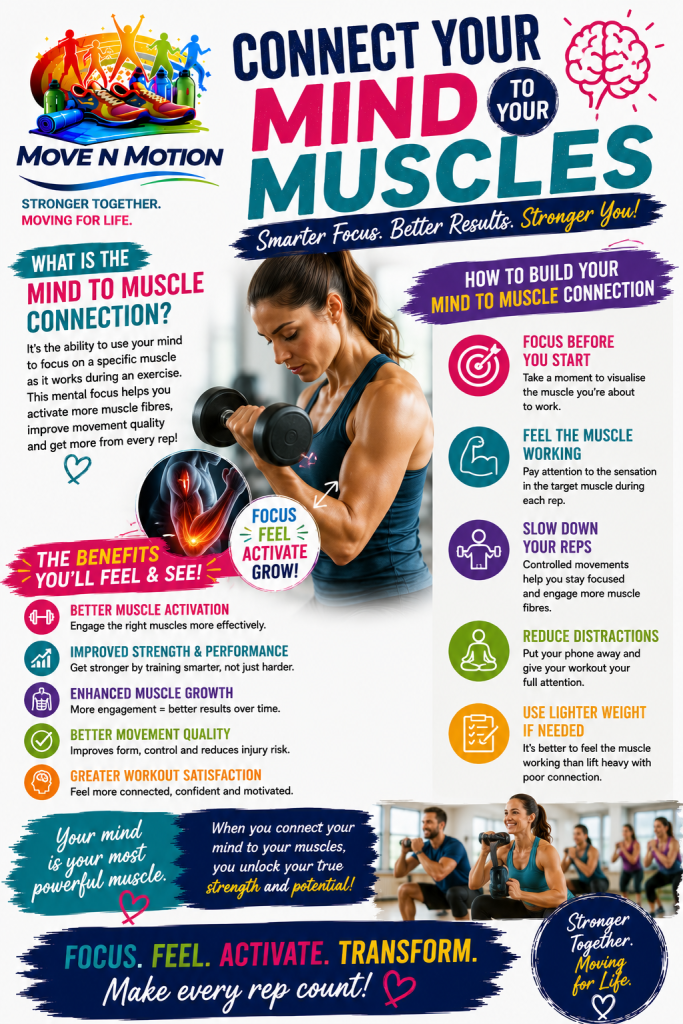
The mind-to-muscle connection is the ability to consciously focus on the muscle you’re trying to work during an exercise.
Instead of simply moving the weight from Point A to Point B, you actively think about contracting and controlling the target muscle throughout the movement.
For example:
During a squat, focus on your glutes and quadriceps doing the work as you stand.
During a bicep curl, think about squeezing your bicep at the top of each repetition.
During a glute bridge, concentrate on tightening your glutes rather than pushing with your lower back.
This mental focus improves communication between your brain and muscles, allowing them to work more efficiently.
How Does It Work?
Your brain controls every muscle contraction through your nervous system.
When you deliberately concentrate on a muscle during exercise, your brain sends stronger and more coordinated signals to that muscle.
Research suggests this increased focus can improve muscle activation, meaning the intended muscles work harder while surrounding muscles are less likely to compensate.
This leads to better-quality movement and more productive workouts.
Benefits of Developing a Mind-to-Muscle Connection
1. Better Muscle Activation
One of the biggest benefits is improved muscle recruitment.
Rather than allowing stronger muscles to take over, you encourage the correct muscles to perform the work.
For example:
Glutes activate more during squats.
Core muscles engage more during planks.
Back muscles work better during rowing exercises.
2. Increased Strength
Lifting heavier isn’t always the answer.
Many people become stronger simply by improving how effectively they recruit their muscles.
When the correct muscles are doing the work consistently, strength improvements often come faster.
3. Better Technique
Focusing on the movement encourages slower, more controlled repetitions.
This often improves posture, balance and body awareness while reducing poor movement habits.
4. Reduced Injury Risk
Poor technique is a common cause of exercise-related injuries.
When you’re concentrating on proper muscle engagement instead of rushing through repetitions, you’re less likely to compensate with joints or surrounding muscles.
Good movement patterns protect your body over time.
5. Improved Muscle Growth
If your goal is building lean muscle, learning to feel the target muscle working can make your training more effective.
Quality contractions are often more beneficial than simply lifting heavier weights with poor technique.
6. Better Balance and Coordination
Because you’re paying attention to your body position throughout each movement, your balance and coordination naturally improve.
This carries over into everyday activities such as walking, lifting, gardening and playing sport.
How to Improve Your Mind-to-Muscle Connection
Slow Down
Avoid rushing through repetitions.
Move with control during both the lifting and lowering phases.
A slower movement gives your brain more time to activate the correct muscles.
Use Lighter Weights
Many people actually benefit from reducing the weight.
If the load is too heavy, your body will naturally recruit other muscles to help complete the movement.
Lighter weights often improve muscle awareness.
Visualise the Muscle Working
Before starting an exercise, picture the muscle contracting.
This simple mental cue can improve activation almost immediately.
Feel the Muscle
Ask yourself:
Which muscle should be working?
Can I actually feel it contracting?
Am I using momentum instead?
The answers help improve body awareness.
Remove Distractions
Put your phone away.
Avoid rushing between exercises.
Give each repetition your full attention.
Quality always beats quantity.
Examples During Common Exercises
Squats
Focus on:
 Driving through your heels.
Squeezing your glutes as you stand.
Feeling your quadriceps control the lowering phase.
Push-Ups
Think about:
Chest muscles pushing the floor away.
Tightening your core.
Keeping your body in one straight line.
Plank
Instead of simply holding the position:
Tighten your abdominal muscles.
Squeeze your glutes.
Push your forearms into the floor.
Keep your shoulders active.
Bicep Curl
Avoid swinging.
Slowly curl the weight while squeezing your bicep at the top before lowering under control.
Glute Bridge
Rather than lifting as high as possible, focus on squeezing your glutes together throughout the movement.
Everyday Benefits
A stronger mind-to-muscle connection doesn’t just improve gym performance.
It also helps with daily activities such as:
Carrying shopping bags
Lifting children
Gardening
Climbing stairs
Standing from a chair
Improving posture
Reducing lower back discomfort
Improving balance as we age
Functional movement starts with proper muscle activation.
Common Mistakes
Many people unknowingly reduce the effectiveness of their workouts by:
Using weights that are too heavy
Performing exercises too quickly
Using momentum instead of muscle control
Copying others without focusing on their own technique
Holding their breath throughout the exercise
Slowing down and focusing on quality movement usually produces better long-term results.
Is This Only for Strength Training?
Not at all.
The mind-to-muscle connection can improve almost any form of exercise, including:
Resistance training
Pilates
Bodyweight workouts
Core exercises
Balance training
Rehabilitation exercises
Functional fitness classes
Even walking can benefit when you focus on posture, core engagement and glute activation.
How We Use It at Move N Motion
At Move N Motion, we regularly coach participants to think about the muscles they’re using rather than simply counting repetitions.
You’ll often hear cues like:
“Squeeze your glutes.”
“Brace your core.”
“Pull your shoulder blades back.”
“Control the lowering phase.”
“Slow it down.”
These simple reminders help participants move better, become stronger and gain more from every class.
Our workouts are designed for all fitness levels, so whether you’re just getting started or looking to improve your technique, we’ll help you build confidence while developing healthier movement patterns.
Final Thoughts
The mind-to-muscle connection is one of the simplest ways to improve your workouts without spending more time exercising or lifting heavier weights.
By slowing down, focusing on the muscles you’re working and moving with intention, you’ll improve muscle activation, strength, posture and technique while reducing your risk of injury.
Remember—it’s not about how many repetitions you complete; it’s about how well you complete them.
At Move N Motion, we’re passionate about helping people move better, feel stronger and build confidence through safe, effective and enjoyable exercise.
Ready to experience the difference?
Join one of our friendly group fitness classes in Widgee, Glastonbury or Kilkivan and discover how moving with purpose can transform your fitness journey.
Book your class today at: