
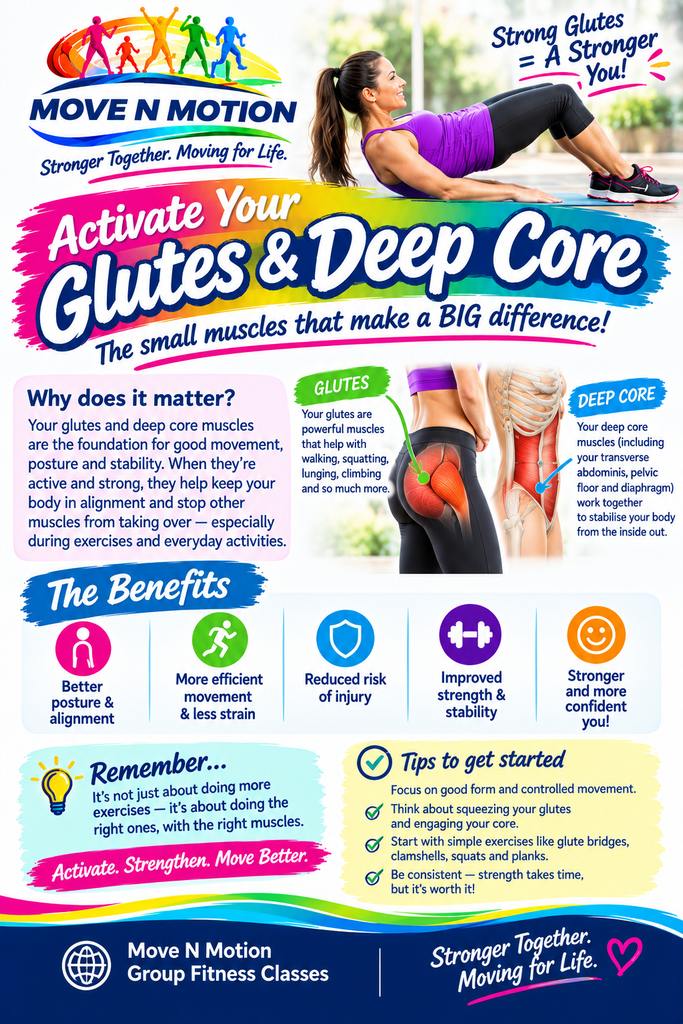
Activate Your Glutes & Deep Core: Why These Muscles Matter for Better Movement
Have you ever performed an exercise and felt it mostly in your thighs, lower back or other muscles instead of the area you were actually trying to work?
Sometimes the answer isn’t simply doing more repetitions or adding more weight. Learning to activate the right muscles and then building strength in them can help you move more efficiently and with better control.
Two important areas to focus on are your glutes and deep core muscles.
At Move N Motion, we encourage our participants to focus not only on completing an exercise, but also on how their body is moving and which muscles are doing the work.
🍑 Why are your glutes so important?
Your glutes are some of the strongest muscles in your body. They play an important role in movements we perform every day, including:
- Walking
- Standing up
- Climbing stairs
- Squatting
- Lunging
- Getting in and out of a chair
- Running and jumping
Strong, active glutes help contribute to hip and pelvic stability and can help you produce force during many different movements.
When your glutes aren’t contributing effectively, other muscles may compensate. For example, you might feel an exercise predominantly in your thighs or lower back when your goal is to target your glutes.
How can you activate your glutes?
Before jumping into a challenging workout, simple activation exercises can help you become more aware of your glutes.
Some great options include:
🍑 Glute bridges
Focus on gently squeezing your glutes as you lift your hips.
🍑 Clamshells
Keep your pelvis controlled while opening your top knee.
🍑 Squats
Focus on pushing through your feet and using your hips and glutes as you stand.
🍑 Lunges
Maintain good control and focus on the muscles helping you return to the standing position.
The goal isn’t necessarily to make these exercises exhausting. Instead, concentrate on feeling the intended muscles working.
💜 What is your deep core?
When people hear the word “core”, they often think about the visible abdominal muscles.
But your core is much more than your six-pack.
Your deep core includes muscles that work together to help provide stability around your trunk and pelvis. This system includes muscles such as the transversus abdominis, pelvic floor and diaphragm, working alongside other muscles of the trunk.
These muscles help your body control and stabilise movement.
Why does deep core strength matter?
A strong and well-coordinated core can help support:
✅ Better posture and alignment
✅ Trunk stability
✅ Balance and control
✅ Efficient movement
✅ Good exercise technique
✅ Everyday activities such as lifting, bending and reaching
Your core doesn’t need to be switched on as hard as possible all the time. Instead, it’s about learning to coordinate your muscles and use an appropriate level of tension for the movement you’re performing.
🎯 Why do other muscles sometimes take over?
Your body is very clever.
If a particular muscle isn’t contributing effectively, your body may find another way to complete the movement.
This is called compensation.
For example, during a glute-focused exercise, you might feel your hamstrings or lower back working more than your glutes.
This doesn’t automatically mean something is wrong. It can simply be a sign that your technique, muscle coordination, mobility, fatigue or exercise selection may need some attention.
That’s why quality of movement matters.
Instead of rushing through 20 repetitions, try slowing down and asking yourself:
“Am I using the muscles I’m supposed to be using?”
🧠 The mind-to-muscle connection
One of the simplest ways to improve muscle awareness is to actually think about the muscle you’re trying to use.
Before starting an exercise, take a moment to identify the target muscle.
For example:
Glute bridge:
“Can I feel my glutes working as I lift?”
Squat:
“Can I feel my hips and legs working together?”
Core exercise:
“Can I maintain control through my trunk without holding my breath?”
This doesn’t mean you need to obsess over every muscle. It simply helps you become more aware of your movement.
💪 Build strength gradually
Activation is only the beginning.
Once you can identify and control the movement, you can gradually build strength by increasing the challenge.
This might mean:
- More repetitions
- Additional sets
- Longer holds
- Greater range of movement
- Light resistance
- Progressing to a more challenging exercise
You don’t need to start with heavy weights.
Consistency is far more important than trying to do too much too soon.
🌟 A simple Move N Motion approach
Try this simple sequence before your next workout:
1. CONNECT
Take a moment to focus on the muscles you’re about to use.
2. ACTIVATE
Use a simple exercise such as a glute bridge or controlled core exercise.
3. CONTROL
Perform your main exercise slowly enough to maintain good technique.
4. STRENGTHEN
Gradually increase the challenge as you become stronger.
5. MOVE
Take that improved strength and control into your everyday activities.
🍑 Strong Glutes + 💜 Strong Core = Better Movement
Your goal doesn’t have to be perfect technique or having a “perfect” body.
It’s about becoming stronger, more confident and more aware of how your body moves.
At Move N Motion, we believe fitness should be accessible, supportive and enjoyable for everyone.
Whether you’re new to exercise, getting back into fitness or simply looking to improve your strength, learning to activate and strengthen your glutes and deep core can be a valuable part of your fitness journey.
Activate. Strengthen. Move Better.
💜 Move N Motion – Stronger Together. Moving for Life. 💚